chapter 1
Introduction:
Documentation should be
regarded as a living heritage one that must be enriched and transmitted rather
than as a burden inherited from the past. The great pioneers of the field, such
as Paul Otlet and Suzanne Briet, laid the foundations for a discipline that is
constantly evolving, grounded in the dissemination of knowledge and access to
information. Their legacy should not merely be commemorated, but extended
through continuous adaptation to technological developments and the emerging
needs of contemporary societies.
Looking back at the past allows us to better understand the origins of documentation, but it is through the use of digital tools and new documentary practices that today’s professionals can truly advance the field. Thus, while the core values of documentation organizing, preserving, and sharing knowledge remain unchanged, the methods used to achieve these goals are in constant transformation.
1. Concepts and Definitions:
Documentation involves gathering, organizing, selecting, disseminating, and using different types of information. It is both an art and a science that allows knowledge to be structured and managed for the benefit of all disciplines and fields of expertise. In its modern form, documentation was developed by Paul Otlet at the beginning of the 20th century.
The processing of information and advances in communication technologies have had a positive impact on numerous fields. Without them, scientific research would not have reached its current level of importance, especially given the speed at which these technologies continue to evolve. Documentation has therefore become an essential tool for the management of many human activities, particularly in the economic sector and in business strategy (market studies, country analysis, etc.).
Moreover, its influence extends into everyday life: information directly shapes human relationships. Although human behavior is not determined solely by available information, individual decisions remain limited by what one knows at a given moment. This explains the considerable growth of popular science publications.
A document may be defined as a structured set of information recorded on a material medium in a stable and reproducible form, intended to be read or interpreted by humans and/or machines (International Organization for Standardization definition).
Ø Five essential characteristics make it possible to identify a document:
1) It contains information.
2) This information is organized in an intelligible and readable way.
3) It is recorded on a transportable, reproducible, and relatively stable medium.
4) The document serves a specific purpose (informational, educational, legal, etc.).
5)
Its content is considered complete and finalized.
(Definition by R. Escarpit)
A document fulfills two essential functions:
Ø Preservation: It serves as a record of the activity of an individual or an institution, functioning as both a memory and, in some cases, as evidence.
Ø Communication: It disseminates knowledge, supports learning, and conveys the author’s perspective.
Example:
In a university library, the primary objective is the dissemination of knowledge.
In contrast, in archival centers, the priority is the preservation of official and historical documents.
2. The Different Types of Documents:
The notion of “document” is broad and sometimes ambiguous. To carry out an effective documentary search, it is essential to identify, distinguish, and characterize the main sources of information.
In a university library, access to information is provided through a wide variety of documents such as academic textbooks, journal articles, or digital catalogues available on different media: paper, digital, or photographic.
Thus, to conduct successful documentary research, it is necessary to know the types of documents that can be consulted, whether in a library or online, because each of them provides specific information, follows a particular classification method, and responds to its own rules of consultation and borrowing.
2.1 Classical Documentation:
Classical documentation refers to printed and physical documents, usually found in libraries and mainly stored on paper — the oldest documentary medium (manuscripts, typewritten texts, printed materials, visual documents). It includes:
2.1.1
Reference works (usuels):
Reference works are the starting point
of any documentary research, because they help to understand and define a
subject. In a library, these reference books are grouped in a separate section,
often located near the entrance. They include encyclopedias, dictionaries, as
well as specialized and bibliographic works.
These works are generally available for on-site consultation only, in order to guarantee access to the largest number of users. Reference works, mainly composed of dictionaries and encyclopedias, are always placed at the beginning of the shelves in each discipline.
Reference works mainly include dictionaries and encyclopedias. In every field, they are positioned at the beginning of the book section.
Dictionaries, which have existed for a long time, are reference books arranged in alphabetical order, written by specialists, and used to provide definitions and information about words. There are several types:
• Language dictionaries
(definitions, synonyms, etymology, translations, etc.)
• Encyclopedic dictionaries (including additional scientific
or historical information)
• Specialized dictionaries (focused on a specific field such
as medicine, history, biography, etc.)
Encyclopedias, offer longer and more detailed articles than dictionaries. They do not cover all the words of a language, but rather develop specific topics written by experts. There are different types:
• Systematic
encyclopedias: organized by disciplines or thematic fields.
• Alphabetical encyclopedias: organized alphabetically with
cross-references between topics (e.g., Encyclopaedia Universalis).
• Encyclopedic collections: each volume deals with a specific
subject, and the entire set
forms a complete encyclopedia (e.g., the Que sais-je? series).
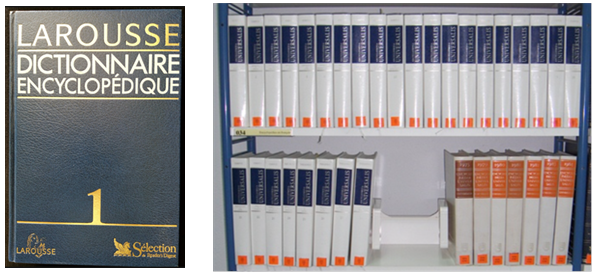
Dictionnaire encyclopédique encyclopaedia Universalis
Classical
documentation, which has long existed
in printed form, also includes several types of reference works. It contains indexes,
which make it easier to search for specific information within a book, biographies,
which recount the lives and works of well-known figures, and bibliographies,
which list the works published on a given subject or by a particular author. Textbooks,
mainly designed for students, present an entire field of study and serve as a foundation
for learning. Directories, published each year, provide factual and up-to-date information.
To this are added atlases, rich in geographical, historical, or
scientific maps, and almanacs, which gather a wide range of practical
and varied data each year.
All these works, available in printed form, have long served as an essential
starting point for documentary research.
1.1.1 Books (Monographs):
Books,
also known as monographs, are single publications written by one or several
authors. They are an important source of information and often include a
bibliography or an index to facilitate research.
Two main categories
can be distinguished:
- Fiction works (novels, collections of poetry, plays, sometimes accompanied by critical editions and commentary),
- Documentary works, which may be textbooks, summaries, or specialized studies.
|
|
|
|
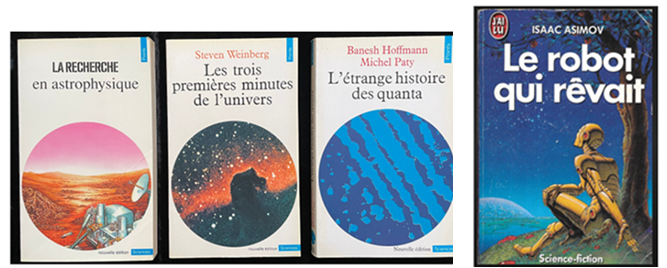
Documentary works fiction works
1.1.2
Periodicals:
Periodicals are ongoing publications that are issued at regular intervals, such
as daily newspapers, weekly magazines, monthly journals, or quarterly reviews.
They bring together, under the same title, articles written by different
authors around a common discipline, field, or area of interes. They are mainly
used to update and supplement basic documentation or to obtain specific,
up-to-date information, making them a valuable source for current events and
research. Several types can be distinguished: newspapers, magazines, and
scholarly journals.
Examples include Le Monde, Le Nouvel Observateur, La Recherche,
Le Recueil Dalloz, or Le Monde de l’Éducation, which brings
together journalists, researchers, and specialists in the field of education.
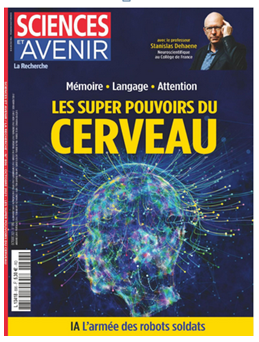
Periodical " LA Recherche"
|
|
1.2 Audiovisual (Multimedia) Documentation:
This type of documentation encompasses materials that combine images and/or sound and require technical equipment for consultation. It includes films, television programs, narrated slideshows, as well as audio documents such as radio or musical recordings, and visual materials such as photographs, engravings, or motion pictures. It also covers specialized formats: photographic (slides, microforms, 35 mm films), magnetic (audiocassettes, videocassettes, floppy disks), and optical media (CDs, DVDs used for educational or recreational purposes).
Objectives:
• Support teaching and training (particularly in medicine and the sciences).
• Disseminate research findings more broadly.
• Preserve materials in specialized media libraries.
• Assist students in learning through more concrete and visual resources.
These documents, often referred to as Digital Audiovisual Archival Materials (DANA), now constitute an essential component of digital and cultural heritage. They are defined by three fundamental elements:
• Content: auditory, visual, or textual information
• Form: medium, format, structure, and temporality
• Context: the social, technical, and archival conditions of their production and use.
The rise of digital technology has transformed the access to and use of these materials, making their sharing, indexing, and creative reuse easier, while also introducing new challenges for preservation and interoperability. Consequently, audiovisual documentation now carries informational, cultural, aesthetic, and emotional dimensions, and requires documentary mediation adapted to new uses and to users’ expectations on the Web.
1.3 Internet Documentation (Electronic/Digital Documents) :
It is based on digital media, which require the use of computer equipment, software, and encoding standards. It includes all resources that can be accessed online. Consultation is often intangible, even though the information can be saved on physical media (USB drives, CDs, printed copies, etc.).
1.3.1 Websites: official sites, blogs, and personal pages. Generally multimedia in nature, they combine text, images, and sound, and are organized into pages connected by hyperlinks.
A website is identified by a URL (Uniform Resource Locator), which provides several useful pieces of information about the document
Example: http://www.univ-constantine2.dz/bu/catalogue/guide.html
http:// → indicates that it is an HTML web page.
www.univ-constantine2.dz → specifies the hosting site: here, Abdelhamid Mehri University – Constantine 2 (Algeria).
/bu/catalogue/ → indicates the path or directory of the project: here the University Library (BU) and catalogue.
guide.html → corresponds to the specific name of the page or document: here, a guide to the online catalogue. The extensions provide additional information:
.ac = academic, .edu = education, .org = organization, .com = commercial.
The final two letters indicate the country (.be = Belgium, .fr = France, .dz = Algeria, .ca = Canada, etc.).
1.3.2 Databases: Databases compile and organize information from journals, books, or theses, allowing access to references and sometimes full texts. They provide search tools by keywords, authors, or topics. In Algeria, the SNDL offers numerous scientific journals, while Europresse provides access to a wide range of press articles and specialized journals. These databases facilitate access to reliable and up-to-date information, which is essential for academic and professional research.
1.3.3 Electronic Periodicals: Electronic periodicals are digital versions of print journals or publications available exclusively online, offering quick access to recent articles with features such as keyword search and full-text download. In Algeria, platforms like SNDL or ASJP centralize numerous scientific and technical periodicals. Internationally, titles such as France-Antilles or La Recherche exist in both print and digital formats. Access may be free or paid depending on the publication.
1.3.4 Other Digital Resources: CD-ROMs, DVDs, and online libraries and archives.
1.4
Bibliography:
A bibliography is a tool that allows
one to identify a document (title, author, year, etc.), determine its
existence, locate it (in which library or database), and sometimes gain
information about its content (abstract, keywords).
It can be classified into several
types:
1.4.1 The Catalogue:
The catalogue is a fundamental tool in the document management of a library, allowing users to locate and identify all the documents it holds. It lists various types of resources, such as reference works, monographs, and audiovisual materials. Regarding periodicals, the catalogue indicates the titles to which the library is or has been subscribed, specifying the available volumes and issues, as well as any missing numbers when applicable. In addition to providing a complete inventory of its collections, the catalogue offers essential information about the location of documents within the library and their availability for consultation or borrowing.
In Algeria, several libraries provide catalogues that are accessible either online or on-site, facilitating the work of students and researchers. For example, the Catalogue of the National Library of Algeria (BNA) allows users to consult the available books, theses, and periodicals. Similarly, the OPACs (Online Public Access Catalogues) of university libraries provide access to the collections of academic libraries, indicating for each document its location and availability status. Furthermore, the internal catalogues of university libraries complement these systems by listing resources specific to each institution.
These catalogues thus constitute an indispensable tool for documentary research, enabling students and researchers to efficiently locate relevant documents, plan their consultations, and organize their work based on reliable and up-to-date information.
1.4.2 Tables-of-Contents Databases:
Tables-of-contents databases, also known as contents review services, are essential tools for documentary research. They compile and present the tables of contents of periodicals, allowing users to quickly identify recent articles across various scientific fields. These databases may cover Algerian or international scholarly journals available in libraries, as well as international resources such as Electre or French Books in Print. In general, access to titles is free when consulted on-site in the library, while access to the full text of articles may be fee-based or depend on the institution’s subscription. These tools help guide students and researchers toward publications relevant to their work.
1.4.3 Analytical Bibliographies:
Analytical bibliographies provide a detailed description of documents, generally including an abstract of the content, keywords, and precise descriptors. They differ from tables-of-contents databases in the depth of analysis they offer and in the specific domain covered. These bibliographies are mainly distributed electronically, and their use may require payment, although some “light” versions are available free of charge online. They enable students to assess the relevance of a document before accessing its full content, thereby optimizing research time and source selection.
1.4.4 Other Sources of Secondary Information:
In addition to catalogues, tables-of-contents databases, and analytical bibliographies, there exist other secondary sources that help identify the existence of documents or locate them in other libraries. For books, these include national union catalogues, specialized bibliographies, as well as publishers’ and distributors’ catalogues. For periodicals, one may consult databases such as ASJP (Algerian Scientific Journal Platform), DOAJ (Directory of Open Access Journals), or the catalogues of Algerian university libraries. These sources are essential for accessing documents not available locally, and while consultation for location and metadata is often free, access to full-text documents may require a subscription or be fee-based.
2. Stages of Documentary Research (Methodology):
Regardless of the nature of the research project, the documentary research process follows a structured approach consisting of three main stages:
i. Preparation of the research, which involves analysing the research topic and determining the types of documents that can provide relevant information.
ii. The research process itself, which consists of identifying references, verifying their accuracy and relevance, and selecting appropriate information.
iii. Correctly citing sources and presenting a bibliography, in order to avoid plagiarism.
2.1 Analysing the Research Topic:
Analysing the research topic is a fundamental step in clearly understanding the expected work, avoiding off-topic content or omissions, and above all identifying the key questions to be addressed. This process first requires understanding and defining the topic, then examining it in order to structure the research effectively. Such preliminary analysis is essential before beginning any investigation, whether in a library, a catalogue, a database, or on the Internet.
3.1.1 Understanding and Defining the Topic:
i. Carefully read the topic and identify the keywords.
ii. Verify the meaning of essential terms, especially if they are complex, ambiguous, or polysemic. To do this, I may rely on dictionaries or other reference works.
iii. Take a step back to gain an overall view of the topic. Encyclopedias, for example, provide a broad overview.
iv. Understand what a keyword is. A keyword is used to describe the topic and to target its various aspects. Keywords may be general or specific terms, synonyms, related terms, or even translations.
v. Identify the main concepts. To identify a concept, one must:
• retain only relevant words or expressions,
• exclude relational terms (factor, effect, impact, consequence, cause, etc.),
• remove words with no added value (characterization, contribution, study, trend, issue, etc.),
• eliminate function words (how, the, a, of the, this, etc.).
Example:
Research Topic: Use of microbial fermentation
in the production of antibiotics.
Concepts: Microbial fermentation, antibiotic production, micro-organisms
(bacteria, fungi).
Keywords: Fermentation, Antibiotics, Microbes/Bacteria, Penicillin,
Biotechnology.
3.1.2 Questioning the Topic:
Questioning the topic is an essential step for effectively guiding the documentary research process. It also helps direct note-taking by ensuring that only the most relevant information is retained for the work to be produced. By asking the right questions, several possible lines of inquiry can be identified, which can then be explored further through reference works.
Ø 5W1H Method:
The 5W1H method is a mnemonic tool that helps recall a series of simple guiding questions. It makes it possible to better understand, specify, and deepen a topic by examining it from different angles.
Before beginning any documentary research, it is essential to question the topic in order to determine its boundaries and define its framework.
To do so, one may use the journalistic method known as 5W1H: What? Who? When?
Why? Where? How? This approach makes it possible to analyse the topic from
multiple angles, clarify the objectives of the research, and effectively guide
the information-gathering process.
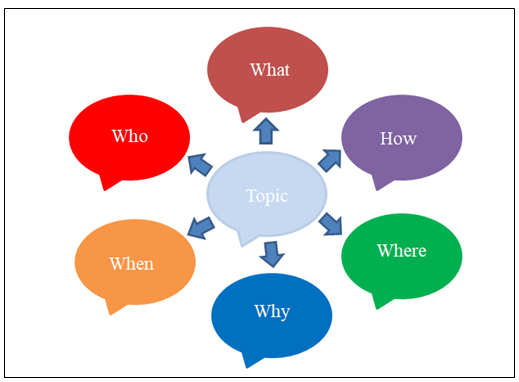
These questions help to better identify the different aspects of the topic and to define its boundaries. They also facilitate the selection of the most appropriate sources and documents for gathering information that is both relevant and consistent with the research objective.
Ø Practical Example:
Questioning the following topic: Lack of resources in Algerian university laboratories.
|
5W1H |
Questions |
Topic |
|
What? |
What is the topic of my research? |
The lack of material and technical resources in Algerian university laboratories. |
|
Who? |
Who is concerned by this study? |
Students, teacher-researchers, technicians, and laboratory managers in chemistry and physics laboratories. |
|
When? |
When does our observation period take place? |
In recent years. |
|
Why? |
Why is it important to study this problem? |
This problem limits the quality of practical teaching and hinders scientific research. Understanding its causes makes it possible to propose solutions to improve experimental conditions and student performance.. |
|
Where? |
What is the geographical scope of the study? |
Algerian universities, particularly the faculties of science (chemistry, physics, biology). |
|
How? |
How has this lack of resources developed? How does it manifest itself? |
Insufficient budgets, administrative delays, and lack of maintenance have led to a shortage of reagents, computing equipment, and modern instruments. Teachers often have to replace practical experiments with theoretical demonstrations. |
3.2 Organizing Documentary Research:
Organizing research is based on careful planning. It involves identifying the available information sources, preparing the necessary materials, and managing time efficiently. This approach helps structure the research, avoid time loss, and ensure the quality and relevance of the data collected.
3.2.1 Procedure
to Follow:
•
Identify the nature of the work to be completed (reading notes, oral
presentation, report, thesis, etc.).
• Adjust the time allocated according to the complexity of the task: a few
minutes for a simple definition search, several days for an in-depth study or
scientific writing.
• Situate the work within its disciplinary and thematic framework (physical
chemistry, biology, education sciences, etc.) to guide the research
effectively.
• Organize practical aspects: plan the schedule, know the opening hours and
access conditions of the library or databases, ensure the availability of
equipment (computer, software, measuring instruments, etc.).
Example:
I am a first-year student in Matter Sciences.
As part of the MTU course, I am required to give a 10-minute oral presentation
on the consequences of industrial pollution on the environment, accompanied by
visual aids (slides or overheads) to illustrate my points.
I begin my preparation at least two weeks before the presentation date to have
enough time to collect reliable information and design my visual aids.
I check the schedule of the multimedia room and the availability of projection
equipment, as well as the possibility of printing my documents in color.
I also plan time at the university library to consult books, scientific
articles, and specialized journals that are not available for loan, in order to
enrich the content of my presentation.
3.3 Choosing Documentary Resources:
After
clearly defining the research topic, it is necessary to select the most
appropriate documentary resources to collect relevant and reliable information.
This step includes two essential aspects:
➔ The type of documents to consult, such as books,
journal articles, reports, or theses;
➔ The tools to access information, such as library
catalogues, specialized databases, scientific portals, or academic search
engines.
The choice of document type depends on the level and nature of the information sought. Each category of source provides specific value to the research:
· Dictionaries and encyclopedias allow for defining, understanding, and clarifying the topic, particularly when it involves new or complex concepts.
· Books or monographs are used to explore a theme in depth, offering detailed and comprehensive analysis. This category includes textbooks, specialized works, essays, and treatises dedicated to a specific field.
· General or specialized periodicals provide regular updates on knowledge and enable tracking the latest research findings or developments in a particular field or in society in general.
· Theses, dissertations, and research reports (often referred to as grey literature): these scientific and technical documents are valuable sources for in-depth study of a specific or innovative topic, often not covered in mainstream publications.
The type of resources to consult varies according to the nature of the topic and the type of document sought. Each resource offers a specific mode of access to information.
i. Library Catalogues:
Library catalogues, often multidisciplinary, are essential tools for locating printed or digital documents available in research and educational institutions. In Algeria, several catalogues provide access to a wide range of documentary resources:
· National Online Documentation System (SNDL) (www.sndl.cerist.dz) brings together the catalogues of Algerian university libraries and provides access to electronic theses, dissertations, and periodicals.
· Catalogue of the University Library of Constantine 1 (bu.umc.edu.dz) allows consultation of books, theses, and research works available across different faculties.
· Catalogue of the National Library of Algeria (BNA) (www.bna.dz) offers access to the national collection, including books, journals, manuscripts, and archives.
· CERIST Catalogue (www.cerist.dz) provides scientific and technical resources intended for the university community and research purposes.
ii. Databases:
Databases allow consultation of scientific articles, electronic journals, and specialized research works:
· National Online Documentation System (SNDL): a national portal providing access to numerous electronic resources (articles, journals, ebooks, theses) for students, teacher-researchers, etc. (revue.enstp.edu.dz + 2 bu.usthb.dz + 2)
· ALGERIANA: a multidisciplinary, multilingual bibliographic database that lists documents produced on Algeria abroad (monographs, theses, articles, conference proceedings, etc.) (dist.cerist.dz +1)
· ASA (Algerian Scientific Abstracts): an analytical, multidisciplinary, multilingual database; it indexes Algerian scientific and technical publications in all formats (dist.cerist.dz +1)
· CAP (Algerian Periodicals Catalogue): identifies and locates Algerian periodical titles; useful for finding journals available in various documentary institutions (dist.cerist.dz +1)
· CAT (Algerian Theses Catalogue) / National Theses Collection (FNT): a database covering Magister and State theses, including location and indexing (arn.dz +2, dist.cerist.dz +2)
iii. Documentary Portals and Scientific Search Engines (Open Access and Institutional)
Documentary portals and scientific search engines aggregate reliable resources from universities, research organizations, or public institutions. They provide access to articles, theses, books, and scientific journals. The following sites are recommended for scientific and academic documentary research:
|
Name of the Portal / Search Engine |
Type of Content |
Access |
Relevance |
|
Google Scholar (https://scholar.google.com) |
Articles, Dissertations, Theses, Citations |
Open Access |
An excellent starting point for finding scientific works |
|
ResearchGate (https://www.researchgate.net) |
Author-Shared Articles |
Open Access |
Direct access to recent publications in chemistry, physics, and biotechnology |
|
PubChem (https://pubchem.ncbi.nlm.nih.gov) |
Chemical data, molecules, reactions |
Open Access |
Highly useful for chemists and pharmacy students |
|
HAL (https://hal.science) |
Articles, Theses, Research Reports |
Open Access |
Open-access French scientific publications. |
|
WorldWideScience (https://worldwidescience.org) |
International databases |
Open Access |
Allows simultaneous searching across multiple scientific portals |
|
CIRS (https://www.cirs.fr) |
Journal and laboratory references |
Open Access |
International directory of scientific organizations |
|
Isidore (https://www.rechercheisidore.fr) |
Academic publications and open data |
Open Access |
Ideal for interdisciplinary research |
|
Thèses.fr (https://www.theses.fr) |
Defended and ongoing theses |
Partially Open Access |
Download available when the author has granted access to the document. |
|
ScienceDirect – Open Access (https://www.sciencedirect.com/open-access) |
Scientific articles |
Open Access |
Recent articles in chemistry and applied physics |
|
DOAJ (https://www.doaj.org) |
Open-access scientific journals |
Open Access |
Excellent source of articles in the exact sciences |
3.4 Define a documentary research strategy :
Defining a documentary research strategy makes it possible to conduct an effective search on a given topic in a library catalogue, a database, or on the Web. This approach helps avoid two common pitfalls: the ‘documentary void’, when the search yields no relevant results, and ‘documentary noise’, when too many references that are not genuinely related to the topic appear.
3.4.1 Rules for an Effective Literature Search:
To obtain precise and useful results, it is essential to adopt a rigorous method when searching for information.
· Avoid stop words, such as articles (the), pronouns, and common verbs, as they do not add meaningful value for search engines.
· Exclude overly general terms that express relationships between ideas (effect, consequences, functions, relations), since they are often not discriminating enough.
· Use quotation marks to search for an exact expression, and vary the keywords by relying on synonym dictionaries (e.g., mind map, heuristic map, cognitive map, concept map).
· Adapt the vocabulary to the databases being used, particularly by identifying the equivalent English terms.
· Be cautious with polysemous words, which may have multiple meanings and distort the search results.
·
Combining Keywords Using Boolean Operators, to
conduct a documentary search that is both comprehensive and relevant, it is
essential to combine keywords according to different analytical perspectives.
The concepts within a given topic may be linked by several types of
relationships, which must be appropriately reflected in the search strategy.
Boolean operators, developed by the English mathematician George Boole, make it
possible to connect multiple keywords and refine the results obtained.
AND: This operator is used to narrow the search. The
results will include all the keywords entered.
Example: solar energy AND photovoltaic retrieves only documents
that address both concepts simultaneously.
OR: This operator broadens the search. The results will include at least one of the keywords.
Example: solar energy OR renewable energies retrieves documents addressing either one or the other.
NOT: This operator restricts the search. The results will contain the first keyword but exclude the second.
Example: solar energy NOT thermal retrieves documents on solar energy while excluding those that focus on the thermal aspect.
3.5 Assessing the
Reliability of Information:
3.5.1 Books and Periodicals:
Before using books and periodicals in academic research, it is essential to evaluate their quality to ensure the relevance and reliability of the information they provide. This assessment is based on several criteria
Verify the source of the document: Check the credibility of the publisher and prioritize academic publications, such as those from University Presses or collections intended for students (e.g., Hachette Université, Armand Colin – Collection U, etc.).
Evaluate the author’s reputation: Review the author’s other publications, read the book’s back cover or bibliographic notes to determine whether they are a specialist in the field. It is also useful to search for the author online (biography, affiliation, contact details).
Analyze the content of the document: Assess the accuracy of the information, the degree of objectivity, the publication date (particularly important for periodicals), and the reading level (research-oriented, educational, or popularization material).
3.5.2 Websites :
Searching for information on the Internet can generate a large number of seemingly relevant results, but only a portion of them is truly reliable. To assess the quality and accuracy of the information found, four essential criteria must be considered, the first of which is the credibility of the source.
a. Credibility of the source:
· Ensure that the webpage originates from a recognized and reliable source.
· Identify the site owner or author (verify their expertise, objectivity, the date the website was created, and how easily it can be accessed).
· Determine whether the author is a specialist or an amateur: a text published by a researcher on their university’s website is more credible than one posted on a personal site.
· Examine the domain type:
.gouv → official governmental institution
.edu or .ac → educational or research institution
.org → non-profit organization
.com → commercial site (often with promotional purposes)
· Consult the homepage: a reliable website clearly presents its purpose, background, methodology, sources, and the contact information of the person responsible for the content. These elements are indicators of credibility and transparency.
b. Quality of Content
· Regular updating of a website is an essential criterion to ensure the reliability of the information it provides.
· Update frequency: a site whose content is updated regularly is more trustworthy than one whose pages are several years old.
· Content consistency: the information should align with the site’s objectives and the target audience.
· Accuracy and relevance: the content must be clear, well-written, and free of errors—frequent mistakes or imprecise language often indicate a lack of reliability.
· References and sources: the presence of citations, bibliographic references, and the author’s name enhances the page’s credibility.
· Hyperlinks: a website containing active and relevant links to other reliable sources adds value to research, as it allows users to deepen and cross-check information.
c. Intellectual Organization of Information
· A well-designed website should allow users to navigate easily and access the information they are seeking quickly.
· Clear and structured presentation: organized content facilitates reading and understanding.
· Internal search tools: the presence of a site search engine, a sitemap, or help tools enables users to find information without difficulty.
· Intuitive navigation: clear links, well-organized menus, and simple ways to return to the homepage contribute to a better user experience and prevent users from “getting lost” on the site.
d. Presentation of Information
· Page loading and software requirements, pages should load quickly, and the site should have the necessary software or provide reliable links to the tools required to access the content.
· Readable and well-organized presentation: information should be displayed clearly, with legible text, appropriately sized fonts, a neutral background, precise headings, and standardized vocabulary.
· Accessible notes and references: citations and references should be easily accessible, for example via hyperlinks allowing users to return to the main text with a single click (especially on academically oriented pages).
· Ease of retrieving information: the site should allow users to easily download, save, or print content, for instance by providing a PDF or printable version of the page.
|
|