Chapter 2
Learning to read
Introduction:
At the university library, books represent the main source of information available to students. You will be required to consult different types of books depending on your needs: university textbooks, which help you grasp the basic concepts related to your study program; reference works or syntheses, which provide an overall and structured understanding of a topic; popular science books, which explain scientific concepts in a simple and accessible way; as well as handbooks and summaries, which allow for quick revision of key points. Finally, specialized works will enable you to deepen your research and acquire more advanced knowledge in a specific field.
1. Use of the Paratext of a Journal or a Book:
1.1 Books:
From a documentary perspective, the book holds an essential place among information sources. It serves as a privileged tool for learning, research, and the dissemination of knowledge. In libraries, it appears in various forms depending on its purpose: the university textbook for training, the reference work for quick fact-checking, or the specialized treatise for in-depth study of a specific field. Thanks to its organized structure, validated content, and educational function, the book remains a fundamental instrument in the construction and transmission of knowledge, both in academic contexts and within cultural life.
1.1.1 Bibliographic Information of a Book:
A book contains several indications that help identify the different
responsibilities involved in its production: intellectual responsibilities
(such as the author or the editor-in-chief), material responsibilities
(including the number of pages or the series), as well as legal information
(such as the ISBN).
All these elements constitute what is known as a bibliographic reference, once
they are presented according to a standardized format.
Compiling a list of bibliographic references is an essential task for any
student, regardless of their field of study.
It is therefore crucial to know how to read, understand, and reconstruct a
reference in order to easily identify, within a book, each of the elements that
compose it.
1.1.2 External Features:
The cover, meaning the rigid part that protects the book, usually displays most of the intellectual identification elements of the work.
1.1.2.1 Front Cover:
It generally presents the title of the work, the name of the author or authors, the publisher’s name, and, in some cases, the reference to the collection or series.
1.1.2.2 Back Cover:
It may also contain a descriptive or analytical summary written by the author, or a promotional presentation provided by the publisher.
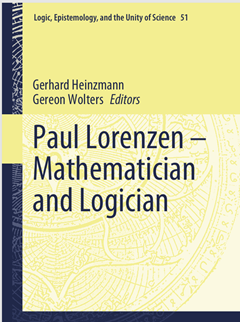
The front cover of a book entitled: Paul Lorenzen- Mathematician and Logician
1.1.3 Internal Features;
1.1.3.1 Title Page:
Inside the book, around the main text, several informational elements help the reader better understand its technical characteristics and intellectual organization. Their presence is generally standardized, making them easy to identify, particularly at the beginning and end of the volume.
The title page restates the identification details already found on the front cover, such as the author’s name, the title, and the publisher—while sometimes adding further complementary information. In all cases, it is more complete and more precise than the external cover.
1.1.3.2 Preface and Introduction
The preface, also called the foreword, is a text placed at the beginning of the book and is most often written by someone other than the author. Its purpose is to present the work,explain its context, or validate its quality. When it is signed by a well-known figure in the field, it may also serve as a mark of credibility or as a promotional argument, and is sometimes highlighted on the front cover.
The introduction, on the other hand, is generally written by the author (or occasionally by an external specialist). It outlines the objectives, approach, and overall structure of the book, thereby guiding the reader in understanding the content.
1.1.3.3 Copyright Notice:
The copyright notice, represented by the letter C enclosed in a circle, specifies the holder of the publication’s intellectual property rights, as well as the year in which these rights were acquired.
1.1.3.4 Identification Number: ISBN
The ISBN (International Standard Book Number) is a standardized
international identification number assigned to every published book. The use
of an ISBN facilitates various management operations, including order
processing, inventory control, and online searching for book professionals
(publishers, booksellers, librarians, etc.).
The ISBN consists of 13 digits (prior to January 2007, it contained 10
digits).
1.1.3.5 Appendix
In publishing, the appendix refers to the set of pages added at the end of a book, gathering supplementary remarks, additional documents, or extra information that could not be integrated into the main text. It generally appears after the last chapter and before the table of contents.
1.1.3.6 Notes:
Notes provide additional commentary intended to explain, justify, or document certain information presented in the main text. They may supply historical background, bibliographic references, or terminological clarifications without burdening the primary narrative. Typically located at the bottom of the page (footnotes) or grouped at the end of the book (endnotes), they help readers understand the content more clearly while preserving the coherence of the main discussion.
1.1.3.7 Colophon:
The colophon is usually found at the very end of the book. It indicates the exact date on which the printing of the book was completed. This technical and administrative detail helps identify the precise moment of printing and may be useful for distinguishing between different editions or reprints of the same work.
1.2 Periodicals (Organization of Information) :
Periodicals are serial publications that contain multiple articles, each representing an independent unit of information. They are issued under a single official title at regular intervals, in the form of successive issues or volumes, which are numbered or dated, and whose publication has no predetermined end.
In a university library, users can access both printed periodicals (in paper format) and electronic periodicals (online).
Like books, periodicals include organizational features that facilitate understanding of their internal structure and intellectual arrangement. These elements help readers navigate the journal more effectively and quickly locate the relevant information.
1.2.1 External
Features:
The description of information visible on the cover page pertains exclusively
to printed journals. In contrast, electronic journals are accessed through
search tools that allow direct retrieval of articles without the need for a
physical cover, as the medium is entirely digital.
1.2.2 Front Cover:
Whether illustrated or not, the front cover provides the essential information
required for the bibliographic reference of the periodical. It typically
includes:
· the title of the journal,
· the issue number,
· the publication date.
1.2.3 Back Cover:
In newspapers and magazines intended for the general public, the back cover
often serves as an advertising space. However, for specialized or scientific
journals, it may contain various useful information, such as the table of
contents for the current or upcoming issue, the sale price, and the ISSN
number, among other details.
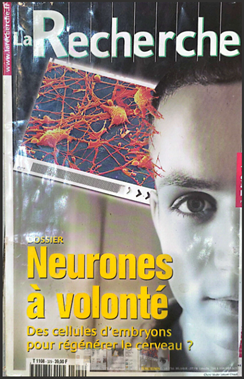
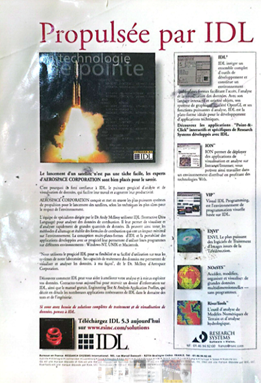
The front and back cover of a periodical entitled: La Recherche
1.2.4
Identification Elements:
Every periodical must include certain identification elements.
a. ISSN
(International Standard Serial Number):
This is a unique international number assigned to every serial publication. It
allows for the identification of each periodical, regardless of its format
(printed or electronic).
An ISSN corresponds to a journal title and its type of medium. It consists of
the abbreviation “ISSN” followed by two groups of four digits separated by a
hyphen, with the last digit serving as a check digit.
Unlike the ISBN for books, the digits in an ISSN have no inherent meaning; they
are simply assigned sequentially without relation to the country, language, or
field of publication.
b. Editorial Team
Information:
These details specify, in particular, the full name of the founder, the
editor-in-chief (responsible for authors), as well as the authors and
illustrators of the periodical.
c. Commercial Information:
This section includes the journal’s trade name, the editorial office address,
the single-issue sale price, as well as subscription rates.
1.2.5 Articles:
Articles constitute the main content of a periodical. Their length varies
depending on the subject matter, and they may be accompanied by illustrations
such as photographs, diagrams, or formulas, as well as an abstract.
Some articles are grouped around a common theme, forming a thematic dossier.
In scientific journals, authorship is mandatory.
In printed editions, articles generally follow one another sequentially
throughout the issue.
2. Learning to Navigate a Book or Document:
2.1 Internal Research Tools in the Book:The table of contents, summary, and index are essential navigational tools that facilitate consultation and understanding of a book’s content. They allow the reader to quickly access chapters, sections, or key concepts. By guiding reading and providing an overview of the text’s structure, these tools ensure effective and methodical navigation within the document.
2.1.1 Content Organization: Table of Contents and Summary
The summary and table of contents indicate the logical structure in which information is arranged in the book—whether chronological, thematic, argumentative, or problem-based. Their main function is to provide an overview of the book’s content.
The summary, placed at the beginning of the book, helps the reader prepare and direct their reading.
The table of contents, on the other hand, is usually located at the end of the book and allows the reader to quickly locate chapters and sections for review or to summarize key information
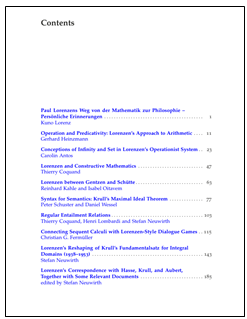
Table of Contents of a booK
2.1.2 Information Location: The Index
Unlike the table of contents or summary, the index does not follow the
intellectual organization of the book but breaks it down to facilitate the
search for specific information (authors’ names, characters, article titles,
places, themes, concepts, definitions, etc.).
It appears as an alphabetical list of keywords accompanied by the page numbers
where they are mentioned. The index is generally placed at the end of the book.
The index plays a crucial role in quickly accessing information across different types of documents:
- In dictionaries, it provides multiple entry points beyond simple alphabetical order.
- In systematic encyclopedias, it facilitates navigation between knowledge domains and helps locate secondary topics mentioned within a main article.
- In printed bibliographies, it allows consultation based on known elements (author, title, or theme).
Thus, the index is a fundamental navigational tool for efficiently exploiting the information contained in any documentary work.
2.2 External Research Tools:
In addition to internal tools, certain external research instruments
allow for deeper and broader knowledge acquisition beyond the book itself.
They provide supplementary information from sources external to the main text.
Among these tools are the glossary or lexicon, which helps understand specific
terms used in the work, and the bibliography, which guides the reader to additional
references to further or enrich their study of the subject.
2.2.1 Bibliography
The bibliography, sometimes called the “hidden” bibliography to distinguish it
from bibliographic works, is located at the end of a volume or chapter in
books, and at the end of an article in encyclopedias. The hidden bibliography
constitutes what is also referred to as the list of reference works. It refers
to the sources used by the author, which in turn serve as starting points for
further exploration of specific aspects of the subject.
2.2.2 Lexicon or Glossary
The lexicon, also called a glossary, organizes the technical or specialized
terms used in the work in alphabetical order.
Each term is briefly defined to help the reader better understand the specific
vocabulary used in the text and to facilitate comprehension of the content.
2.3 Internal Research Tools in a Printed
Periodical
Finding a specific article in a journal requires the use of internal navigation
tools. These tools vary depending on the type of medium: they differ between
printed and electronic journals.
2.3.1 Table of Contents (Summary)
Placed on the cover or among the first pages of the periodical, the table of
contents lists the articles included in the issue.
It provides the titles of the articles in the order in which they appear, along
with the starting page of each article. The table of contents offers an
overview of the topics covered and facilitates the quick location of a
particular article.
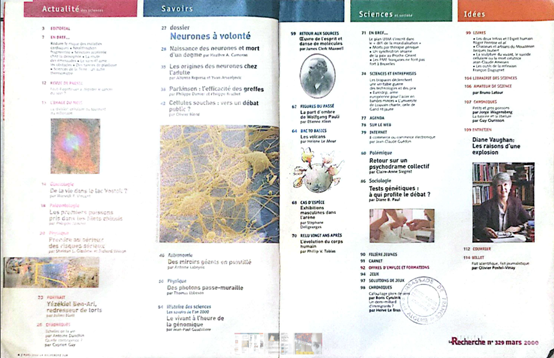
Summary of a periodical: La Recherche
2.3.2 Article Index
The article index presents an alphabetical list of all article titles published
in the periodical.
It allows the reader to quickly locate an article by its title without having
to browse the entire issue.
2.3.3 Keyword Index
The keyword index allows access to articles based on keywords. It lists the
relevant issues and page numbers for each entry. To facilitate retrospective
searches, some indexes are compiled and published cumulatively every five or
ten years.
2.4 Research in an Electronic Periodical
Consulting an article in an electronic journal follows a particular logic,
related to the intangible nature of the medium. Research relies on automated
queries of indexes, similar to printed journals, but providing direct and instant
access to articles. Multiple search methods may be used: browsing the table of
contents, field-specific searches (title, author, keyword, etc.), and employing
advanced or supplementary search functions.
2.4.1 Browsing the Table of Contents
As with a printed journal, the table of contents in an electronic periodical
allows direct access to the various articles it contains.
2.4.2
Field-Specific Searches
Searching for an article can be done by querying one or more fields depending
on the available information.
· Single-criterion search: This involves filling in only one field (e.g., title, author’s name, or publisher) to target a specific element.
· Multi-criterion search: This relies on combining several fields simultaneously. In this case, the system automatically applies the Boolean operator AND to intersect the criteria. Other operators can also be used, such as OR to broaden the search or NOT to exclude certain results.
2.4.3 Using
Different Search Modes
There are three main search modes, each based on a different logic of accessing
information:
· Menu-based search: A multiple-choice menu is displayed at the beginning, inviting the user to progressively select options to refine the search. This mode follows a guided navigation logic, where the user advances step by step until reaching the final result.
· Keyword-based search: This allows the user to locate an article using specific terms present in the bibliographic fields (title, author, abstract, etc.). This method follows a targeted approach, as the user knows exactly what they are searching for and queries the database accordingly.
· Hyperlink-based search: This complements the previous two modes by providing dynamic navigation from the information already found. It follows a free-navigation logic, allowing the user to progress by following links to other authors, articles, or related topics.
Often, electronic search systems combine these three approaches: a title keyword search may lead to a list of references, from which hyperlinks enable exploration of additional documents by the same author or on a similar topic.
2.5 External Tool
(Bibliography)
In both printed and electronic journals, the bibliography, often placed at the
end of an article, gathers the references of documents consulted or cited by
the author during writing — most often other articles.
This bibliography, sometimes called a “hidden bibliography,” is essential in
scientific journals, where it serves as evidence of the rigor and reliability
of the research work.
The bibliographies of research periodicals thus represent a valuable source of
information for the reader, provided they are complete and correctly formatted.
2.6 Knowledge
Capitalization (Through Reading Sheets and Systematic Classification)
Keeping a record of the materials consulted during a research project is a
crucial step in the research process. A reading report (or reading sheet) is
one of the most effective tools for collecting and organizing information. It
generally includes the bibliographic references of the studied document, a
summary, selected excerpts, a personal evaluation, and a set of remarks or
critical observations. Unlike a bibliographic record, which provides only the
essential details for identifying the source, the reading report offers a more
comprehensive overview of the document’s content. Its structure can follow
standard formats or be adapted according to the researcher’s own method and
preferences.
3.1 A reading sheet:
A reading sheet is a concise written document structured like a report or a memo, based on the main framework and the essential ideas extracted from a textual source (such as a book, collection, or article). It is considered a secondary, useful, and personal document. This pedagogical activity, which serves as an essential learning tool widely used in academic and educational settings, results from a careful and in-depth reading of the materials consulted.
A reading sheet serves as a practical instrument for organizing and retaining the essential elements of a consulted source. It enables the reader to note the main ideas developed in the document, the issues explored, the author’s reasoning and methodology, along with significant quotations or passages. Its purpose is to provide a reliable reference that supports the development and writing of one’s own research work or academic study.
3.2 How to present your reading sheet :
Use A4-sized sheets, preferably made of thick paper.
It is recommended to write only on the front side of the page.
To create a well-organized and easy-to-read reading sheet, make sure to clearly separate the different sections.
Use different colors for titles, paragraphs, and key points. Sometimes, a reading sheet for a single document may consist of several pages.
In that case, be careful to number the pages properly to avoid any confusion.
Each page should include, on the back side, the complete bibliographic reference of the document in question.
3.3 Method of Writing a Reading Sheet:
There are several methods for writing a reading sheet. In fact, the choice of
method depends not only on your research needs but also on your ability to
remember information. In other words, some people need to write everything
down, while others can manage with brief notes. However, the most common method
consists of recording the following elements:
i.
The Most Complete Possible Bibliographic
Reference of the Document:
It must be accurate, as it will be essential when preparing the final
bibliography of your research work. The information to record depends on the
type of document consulted. For example, in the case of a book, you should note
the following details: the title, the author’s name, the year of publication,
the publisher, the place of publication, and the total number of pages.
ii.
Author’s Profile:
By mentioning the author’s full name, you should write a short paragraph that
includes the following information: their nationality, date of birth (and
death, if applicable), field of research, as well as their main scientific or academic
works.
iii.
A Summary of the Document:
It is important to include the following elements: the topic addressed by the
author, the objective of the research, the nature of the study conducted, the
type of research, the research findings, and the conclusion.
iv.
Copying the Passages You Wish to Keep :
It is essential to remember that these passages must be placed in quotation
marks and accompanied by the page numbers from which they are taken. These
rules, however, do not apply if you choose to rephrase (paraphrase) the
selected passages in your own words.
v.
Personal Evaluation :
You should conclude your reading sheet by noting the relevance of the document
to your research topic, its importance, its usefulness, and its limitations.
3.4 Model of a Book Reading Sheet:
Complete Bibliographic Reference:
Book Title: ....................................................
Author: ..........................................................
Publisher: .........................................................
Place of Publication: ...........................................
Year of Publication: ............................................
Number of Pages: ...............................................
Author Information:
Full name, nationality, significant dates, research field, main scientific works...
Summary of the Document:
Present the key elements: topic, objective, research method, results, conclusion...
Important Passages:
Quote significant excerpts between quotation marks with the corresponding page numbers.
Personal Evaluation:
Express your opinion about the book’s relevance, scientific contribution, usefulness, and limits...