Chapter 3
1.Definitions:
Note-taking serves the essential function of gathering and organizing information delivered during a lecture, found in a book, or encountered in any learning situation that requires later recall. It is, therefore, a pedagogical activity through which each learner records various forms of lessons (oral, audiovisual, or written) on paper or digitally, using their own language and structure. This learning technique represents an external storage system for processed information (Lindberg-Risch & Kiewra, 2015) and acts as an external memory aid (Piolat, 2001).
Furthermore, note-taking is a methodological skill that promotes learner autonomy (Guillon, 1999–2000). It is a personal and individualized practice that contributes to the development of self-directed learning. The notes taken, memorized, and internalized are later assessed during examinations. As Mangiante and Parpette (2010) explain, notes constitute a temporary and highly personal written record, which each learner structures according to their own preferences. With the rise of digital technology, new personal and digital organization methods have emerged — for instance, David Allen’s GTD (Getting Things Done) approach. In this sense, note-taking goes beyond the mere transcription of information; it involves managing, processing, and generating new knowledge.
Taking notes is not merely copying what the speaker says or transcribing a written text. It involves listening, understanding, processing, and assimilating ideas. Note-taking is an intellectual activity that develops one’s analytical and synthetic thinking: distinguishing what is essential from what is secondary, identifying the main idea of a text, and differentiating between a key concept, its development, and its examples.
Note-taking allows learners to retain the essential content of a lecture, meeting, or reading _ both mentally and in written form. There is no universal method or magic formula; each individual must develop their own note-taking strategy, their own approach (whether linear, schematic, or otherwise), and their own system of symbols and abbreviations. This is why it can often be difficult to interpret someone else’s notes.
Taking notes  writing
down only the essential information as quickly as possible. It therefore
requires the ability to select and organize information efficiently.
writing
down only the essential information as quickly as possible. It therefore
requires the ability to select and organize information efficiently.
1.1Why Take Notes?
a) Memorization of transmitted information:s
This mental ability serves a dual function. The capacity to assimilate,
understand, and preserve information in written form differs from one person to
another. Indeed, one may record information that is incomplete, useless, or
even distorted.
According to specialists, we can retain on average:
- 20% of what we hear,
- 40% of what we see,
- 60% of what we hear and see simultaneously (in an audiovisual context),
- 80% of what we do (speaking, writing, etc.).
The average speaking rate is 130 to 180 words per minute,
while the average writing capacity is 27 to 40 words per minute.
Therefore, note-taking allows one to actively participate in learning, developing critical thinking, and preparing for research or exams. Consequently, note-taking is the key to memorization.
b) Later (Re)use of information:
This involves taking notes from a lecture, conference, presentation, or
book.
c) Information restitution:
This means collecting, reporting, and transmitting information for oneself
and/or for others through a phone call, email, summary note, presentation,
letter, meeting report, and so on.
d) Efficiently solving a problem related to the production of a scientific paper, reading sheet, report, or even an algebraic equation.
1.2The Tools of Note-Taking
Ø Pens / Pencils and Paper:
These are the traditional tools used for taking notes. They allow for quick, personal, and
flexible writing.
Ø
Technological
Tools:
Devices such as computers, tablets, and smartphones can also be used for
note-taking. The digital generation has become accustomed to typing on a
keyboard.
Nowadays, we can see the rise of many free software programs and applications related to note-taking. Most of them are of Anglo-Saxon origin, such as Evernote, OneNote, Google Keep, Simplenote, and Any.do.
These applications allow users to add images, sounds, and digital data to their written notes, making note-taking more interactive and multimedia-oriented.
2.Lecture and Conference Notes:
a.First Stage: Before the Lecture
This stage involves preparing to receive information. It requires both
psychological preparation (attention, concentration, active listening) and
material preparation (tools for memorization and review).
This
includes:
- having a notebook or note-taking sheet with sections and dates,
- choosing pens or pencils,
- reviewing notes from previous classes,
- checking the course syllabus,
- and doing some preliminary reading on the topic.
b. Second Stage: During the Lecture
This stage consists of selecting which information should be written down. It requires choosing an appropriate note-taking method and staying alert. This prevents the student from copying the instructor word-for-word.
Intellectual Process
The note-taker must be able to:
- use techniques such as shorthand or audio recording tools,
- identify and select key information,
- understand the structure of the message and outline it,
- synthesize ideas and developments,
- and master a personal method of taking notes.
Note-taking functions as part of an information and communication system, as shown in the diagram illustrating the process of production.
c. Third Stage: After the Lecture
This final stage consists of reading, completing, organizing, highlighting, understanding, and retaining the notes.It is essential to complete the notes the same day if possible, because after 24 hours, 50% to
80% of the content is forgotten, and after two weeks, more than 80% disappears from memory.
This stage is crucial for revision and assessment. It is also linked to the Cornell Note-Taking System, which includes verifying, correcting, adding missing information, and self-questioning.
3.Note-taking methods:
There are four main methods of note-taking, as shown in the following figure01:
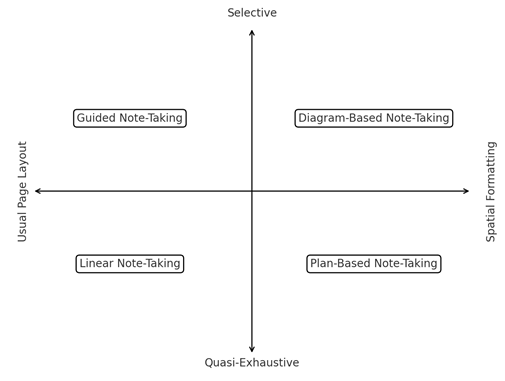
Figure 01: Four Note-Taking Methods
Axis 01 represents the degree to which the notes are selective in relation to the original information (whether spoken or written).
Axis 02 refers to the way the page is used: either in a standard linear text format or in a spatially organized format (visual or hierarchically structured) (Simonet, J., & Simonet, R., 2011: 29).
3.1. Linear Method
This is a convenient and very old method; it is the most common, spontaneous, and least selective of all existing note-taking techniques. It does not require any structuring of ideas or page organization. This word-for-word style of note-taking is exhausting on all levels (physical, psychological, and mental) (Simonet & Simonet, 2011: 29).
However, it is important to note that this method is also a functional and hierarchical approach linked to the Anglo-Saxon method known as “Cornell”. This method consists of six (06) steps: record, reduce (question), recite, reflect, review, and recap (Simonet & Simonet, 2011: 26), as illustrated in Figure below.
In practice, the page must be divided into four sections (front side only): the left column (no. 4) covers one-third of the space, while the right column (no. 2) covers two-thirds. A narrow space must be left at the top (no. 1) and another at the bottom (no. 3). The back side of the page is reserved for adding personal comments, details, illustrations (diagrams, definitions, or formulas).
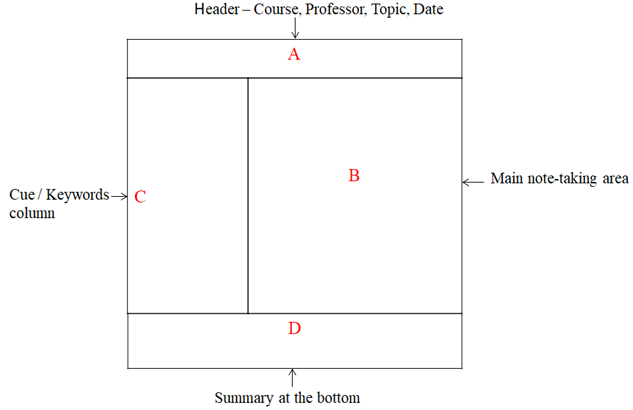
Figure 02: The Cornell System
Area A contains the name, date, course title, topic, and main idea.
This information makes it easy to quickly locate the content you are looking
for.
Area B is used during the lecture.
It is where you take brief, well-spaced notes about the lesson.
The writer uses short and simple sentences, abbreviations, lists, arrows, etc.
After class, this area can be completed, expanded, and highlighted to mark key
points.
Area C is used after the lecture or during review.
It includes keywords, important questions, numbers, and warning symbols that
help recall essential ideas.
Area D is designed to create a concise summary of the most important points on
the page, including key ideas and main references.
It can be consulted during or after the course, and especially when studying
for revision.
3.2. Structured Method
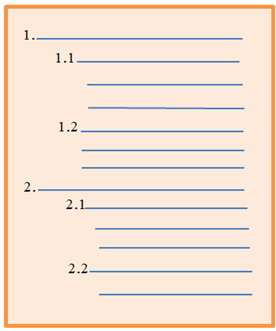
This hierarchical technique makes it possible to record and clearly organize a
large amount of information in the form of a structured outline, following the
order in which it is presented (low selectivity). It is also referred to as the
planning technique, the planned method, the logical method,
or the scientific numbering method.
It is used when the main ideas are
arranged, organized, and classified according to a numbered and listed
structure (titles and subtitles) (Simonet, J., & Simonet, R., 2011: 29).
See the illustration in Figure 03: Structured Method.
3.3 Guided Method
In this approach, the note-taker can determine in advance the themes or categories that will be taken into account while receiving and recording information.
It is a note-taking technique based on a predefined guide, which explains its name. It is also known as the pre-planned method, pre-structured method, or standardized method, because it helps select essential information and prevents omissions.
This method is widely used in learning contexts (interviews, surveys, assessments, lectures) as well as in professional settings (meetings, phone calls). Several types of documents are related to it, such as phone call forms, reports, and various tables.
Its main disadvantage is that it is restricted to the format of the form being used. As an example, the following model shows a telephone call record sheet (Figure n°04).
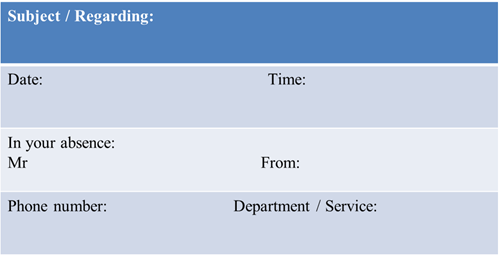
Figure 04: Guided method
3.4 Visual Method:
This is a systematic form of note-taking
that represents the associative flow of thought in a graphic and dynamic way.
It highlights a central theme and shows its branches linking to related
concepts, ideas, and specific pieces of information. Examples include diagrams,
geometric shapes (arrows, circles, rectangles, and squares).
This method requires organizing ideas through branching. It is connected to a highly creative and synthetic memorization technique known as the tree method or keyword method. A common illustration of this is the heuristic diagram or mind map, as shown in Figure 05.
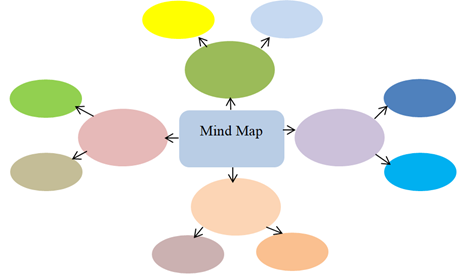
Figure 05: mind map
4.Abbreviations and Symbols :
The skill of taking notes during lectures is not about writing every word the speaker says, but about selecting the key ideas and noting them in a shortened form. This allows you to follow the lecture more easily, and by turning ideas into abbreviations and symbols, you also reinforce them in your memory.
When taking notes, you can
make your writing shorter by reducing the amount of language you use.
There are several ways to do this:
- leave out articles and conjunctions (such as the, a, and, but)
- shorten words by removing vowels or unnecessary letters (this is called word truncation)
- use symbols and abbreviations for words or expressions that appear frequently
However, it is essential to remember what each abbreviation or symbol represents when you review your notes later. The following tips can help:
- Only use abbreviations and symbols that are useful to you and easy to remember. Using too many can make your notes confusing.
- Be consistent: the same abbreviation or symbol should always have the same meaning, otherwise your notes may become unclear.
- Keep a personal list of your abbreviations with their full meanings. Add new ones as you create them so you can refer back to the list if needed.
Here are a few additional tips for effective note-taking:
- Use colours or special marks to show structure. For example, blue for section titles and green for examples.
- Mark places where information is missing so you can complete it later, such as using a long line (———) to indicate gaps.
- Create your own symbols related to the subject you are studying. For instance, in a literature course, you might put the first letters of a character’s name inside a box to refer to that character.
4.1.llustrations of word truncation :
|
ppl |
People |
Bio |
biology / biological |
|
res |
Research |
Phys |
physics / physical |
|
natl |
National |
Diff |
difference / differential |
|
eqn |
Equation |
Var |
variable |
|
ed |
Education |
Const |
constant |
|
gov |
government |
Func |
function |
|
dep |
department |
Coeff |
coefficient |
|
esp |
Especially |
Obs |
observation |
|
ustand |
understand |
Hyp |
hypothesis |
|
exp |
experiment |
Theo |
theory / theoretical |
|
calc |
calculation |
Stat |
statistics |
|
approx |
approximate |
Env |
environment |
|
temp |
temperature |
Evol |
evolution |
|
vol |
Volume |
Gen |
general / genetics |
|
conc |
concentration |
Org |
organism / organic |
|
sol |
solution / soluble |
Micro |
microbiology |
|
rxn |
Reaction |
Macro |
macroscopic |
|
chem |
chemistry |
Homog |
homogeneous |
|
trans |
transformation |
Heterog |
heterogeneous |
|
meas |
measurement |
Thermo |
thermodynamic |
|
quant |
quantity /quantum |
Comp |
component |
|
inter |
interaction |
|
|
4.2.Standard symbols and abbreviations :
|
Symbol / Abbreviation |
Meaning |
|
~ |
Approximately |
|
esp |
Especially |
|
w/ |
With |
|
b/c |
Because |
|
w/o |
Without |
|
@ |
At / About |
|
Wh/ |
Which |
|
# |
Number |
|
* |
Most important |
|
% |
Percent |
|
+/& |
And / Or more |
|
?/Q |
Question |
|
ff |
Following |
|
/ |
Per / Each |
|
< |
Less than |
|
b/w |
Between |
|
> |
Greater than |
|
∴ |
Therefore |
|
= |
The same as / Equal to |
|
Δ |
Change |
|
≠ |
Not equal to |
|
amt |
Amount |
|
→ |
Leads to / Results in |
|
re |
Regarding |
|
↔ |
As a result of / Consequence of |
|
"" |
Repeating the same information |
|
↓ |
Decreasing |
|
↑ |
Increasing |
|
Thru |
Through |
|
vs. |
Versus |
|
p. |
Page |
|
pp |
Pages |
|
etc. |
Etcetera |
|
e.g. |
For example |
|
i.e. |
That is |