Chapter04
1.Guidelines for Effective Academic Writing:
1.1 The Principles of Academic Writing :
Academic writing is generally formal, objective, and technical. It is formal because it avoids casual or conversational expressions, such as contractions or informal vocabulary. It is objective and impersonal because it focuses on facts, concepts, and evidence, rather than on people or emotions. It is technical because it uses specialized terminology specific to each discipline.
Each academic field also follows its own writing style and structure. For instance, in the humanities, paragraphs are often longer and begin with topic sentences that guide the reader through the argument. In contrast, scientific writing tends to use shorter, denser paragraphs filled with factual information and usually omits topic sentences.
To become an effective academic writer, you must learn the specific conventions of your discipline and adapt them to each task. You can do this by:
- Asking your lecturer, supervisor, or tutor for guidance.
- Studying the writing style of articles published in leading academic journals in your field.
- Reviewing successful examples of student work in the same subject area.
a. Formal Language
You can make your writing more formal through careful word choice. In academic writing:
- Use formal rather than informal vocabulary. For example, somewhat is more formal than a bit, and insufficient is more formal than not enough.
- Avoid contractions. Use did not instead of didn’t.
- Avoid emotional or overly strong language. Replace words like wonderful or terrible with more neutral terms such as helpful or problematic.
- Use cautious expressions instead of absolute statements. For instance, say strong evidence rather than proof, or less convincing instead of wrong.
b. Objective Language
Although academic writing should be impersonal, you may still need to express your own perspective—for example, when you:
- Interpret results.
- Evaluate a theory.
- Develop an argument.
- Critique other researchers’ work.
To remain objective while expressing your viewpoint:
- Focus on facts and
ideas, not on people or feelings.
→ Instead of I believe the model is valid, write These findings indicate that the model is valid. - Avoid subjective or emotional language. Use valid or did not demonstrate rather than amazing or disappointing.
- Be cautious and measured. For instance, say There is evidence to suggest that... instead of I think that...
- Support your
position with credible sources. Refer to established researchers or
theorists to strengthen your claims.
→ For example: As Halliday (1973) argues, language is intrinsically social.
Keep in mind that expectations differ across disciplines. In some fields, using the first person (my view is that...) is acceptable, while in others, it is discouraged. Always check the conventions of your subject area and consult your lecturer when in doubt.
c. Technical Language
In addition to being formal, academic writing should also be technical. This involves developing a strong command of discipline-specific vocabulary. To achieve this:
- Take note of the terminology used by your lecturers, tutors, and readings.
- Be aware that some terms have different meanings in different disciplines. For example, the word discourse may refer to different concepts depending on the field.
- Learn and apply the key categories and relationships used in your discipline. For example, in Law, legal systems are divided into common law and statute law. Understanding such distinctions will help you structure your writing and make it more analytical and precise.
1.1 The Essential Elements of Writing :
Writing is, above all, the act of communicating ideas clearly, coherently, and effectively, while respecting the formal and stylistic rules of written language. Writing is therefore an essential activity in the academic field, as it allows one to convey information, express ideas, and share personal reflections with the reader. It goes beyond the simple act of composing sentences—it represents a genuine process of constructing thought and shaping knowledge.
The standards of written communication are based on three essential elements: style, punctuation, and presentation of the written work.
a) Style:
The writing style should be both effective and rich, relying on the fundamental
structure of the French language. It encompasses several key qualities that
must be observed:
- Clarity of vocabulary: The language used should be precise and concrete, employing simple and straightforward words in their proper sense.
- Clarity of thought: Ideas must be clearly expressed. Each paragraph should contain only one main idea, with smooth transitions between paragraphs following a logical order.
- Clarity in punctuation: The punctuation of the text must be correct and consistent.
- Readability: A well-chosen vocabulary, proper sentence structure, adherence to spelling conventions, and neat writing all contribute to making the text easy to read.
- Originality: This is achieved by varying expressions, using synonyms, and avoiding unnecessary repetition.
- Harmony: It depends on the coherence between words and sentences. Sentences should be short and fluid, and repetition of the same terms should be avoided.
b) PUNCTUATION:
Punctuation is the "breath" of a text. In written communication, it
plays a crucial role. Indeed, it helps structure a text grammatically and
allows the reader to understand the meaning of a sentence. A text without
punctuation marks becomes incomprehensible.
Punctuation rules must be followed as carefully as spelling rules. There are two main types:
· Grammatical punctuation: This involves the use of punctuation marks such as “.”, “,”, “;”, “:”, “?” etc.
· Expressive punctuation: This is used to convey emotions, attitudes, or to attract the reader’s attention visually by repeating marks, for example: “!..?..?..”
c). PRESENTATION OF THE WRITTEN WORK
Its purpose is to capture the reader’s attention and lead them to discover the
message or the text, depending on the type of document. This can be achieved
through:
· The organization of the content, including the introduction of quotations, their references, and the bibliography, as well as the use of visual elements such as tables, charts, diagrams, and photographs.
· The layout, which involves the choice of paper, margins, typography (titles, subtitles, and body text), colors, underlining, spacing, text alignment, paragraph arrangement, and page numbering.
· The overall structure, which includes the title page, table of contents, appendices, introduction, summary, and conclusion.
2. Different types of writing for different purposes:
The four main types of academic writing are descriptive, analytical, persuasive, and critical. Each type serves a distinct purpose and uses specific language features.
In most academic papers, you’ll often need to combine more than one writing style. For example, in an empirical thesis:
- The literature review involves critical writing to highlight gaps or opportunities in previous studies.
- The methodology section is mostly descriptive, summarizing the methods used to gather and analyze data.
- The results section tends to be both descriptive and analytical, as it reports and examines the collected data.
- The discussion section is mainly analytical, as it connects your findings to the research questions, and also persuasive, as you present and justify your interpretations of the results.
a) Descriptive :
Descriptive writing is the most basic form of academic writing. Its main goal is to present facts or convey information. For instance, it may include summarizing an article or reporting the outcomes of an experiment.
Typical instructions for a purely descriptive task include terms such as “identify,” “report,” “record,” “summarize,” and “define.”
b) Analytical:
At the university level, it is uncommon for a text to be entirely descriptive. Most academic writing also involves analysis. Analytical writing includes description but goes further by reorganizing the information into categories, groups, parts, types, or relationships.
In some cases, these categories or relationships are already established within the field of study, while in others, you create them yourself. For instance, when comparing two theories, you might divide your comparison into sections such as: how each theory addresses the social context, how it approaches language learning, and how it can be applied in real situations.
Typical instructions for an analytical task include: “analyze,” “compare,” “contrast,” “relate,” and “examine.”
To make your writing more analytical:
- Spend enough time planning. Brainstorm your ideas and facts, and explore different ways to organize them based on patterns, similarities, differences, or components. Visual tools like color-coding, flowcharts, tree diagrams, or tables can help.
- Assign clear names to the relationships or categories you identify, such as advantages and disadvantages.
- Structure each section or paragraph around one analytical category.
- Ensure your paper’s organization is easy to follow by using topic sentences and a well-structured introduction.
c) Persuasive:
In most forms of academic writing, you are expected to move beyond analysis and engage in persuasive writing. This type of writing includes all the features of analytical writing—providing and organizing information—but also introduces your own viewpoint. Most essays are persuasive, and research papers usually include persuasive elements, especially in the discussion and conclusion sections.
In academic contexts, a point of view can take the form of an argument, recommendation, interpretation of results, or evaluation of others’ work. Every claim you make must be supported by evidence, such as research findings or credible published sources.
Typical instructions for persuasive writing include: “argue,” “evaluate,” “discuss,” and “take a position.”
To develop your own perspective on the topic:
- Review other researchers’ viewpoints and decide which you find most convincing.
- Identify patterns or trends in the data or literature, and determine where the evidence is strongest.
- Consider multiple interpretations of the facts. Reflect on the real-world implications of each one and assess which are most beneficial or problematic.
- Discuss your ideas with others and evaluate whether you agree or disagree with their perspectives.
To build your argument:
- List the reasons supporting your point of view.
- Identify the types and sources of evidence that can strengthen your position.
- Compare your viewpoint to those of other researchers, noting both similarities and differences.
- Break down your argument into clear components, such as cost-effectiveness, environmental sustainability, or practical applicability.
When presenting your argument, ensure that:
- Your text forms a coherent argument, where all points work together to support your main position.
- Your reasoning is clear and logically connected.
- Your assumptions are sound and well-founded.
- Each claim is backed by relevant and convincing evidence directly related to your argument.
d) Critical
Critical writing is frequently used in research papers, postgraduate studies, and advanced undergraduate work. It shares all the characteristics of persuasive writing, but adds an important element — the consideration of at least one additional point of view. While persuasive writing focuses on presenting your own argument, critical writing requires you to examine and compare multiple perspectives, including your own.
For instance, you might describe another researcher’s argument or interpretation and then evaluate its strengths and weaknesses, or present an alternative explanation based on your own analysis.
Typical critical writing tasks include writing a critique of a journal article or producing a literature review that discusses both the advantages and limitations of previous studies. Common instruction words for critical writing are: “critique,” “debate,” “disagree,” and “evaluate.”
To write critically, you should:
· Accurately summarize all or part of the work, identifying its main ideas, assumptions, or methodology.
· Form your own opinion about the work. This may involve highlighting its problems, suggesting a more effective approach, or defending it against criticism.
· Support your viewpoint with evidence, such as logical reasoning, references to credible sources, or research data — depending on your discipline and assignment type.
Critical writing demands advanced writing and analytical skills. You must have a deep understanding of the subject and related issues. Additionally, your essay and paragraph structure should enable you to compare interpretations, analyze arguments, and present your own evidence-based position clearly and convincingly.
3. Writing Strategies:
3.1. Planning Your Writing:
Effective academic writing starts with careful planning. There are two main approaches to organising and analysing information:
a)
Planning approach:
Spend time planning thoroughly before writing. Only begin writing when you know
what each paragraph will cover.
b)
Drafting approach:
Start writing early while still developing your ideas. Write multiple drafts
and reorganise your work until your ideas are clear and paragraphs well
structured.
3.2. Understanding Expectations:
Before starting, understand exactly what type of assignment you are expected to produce, as expectations may differ between disciplines or even lecturers. Common types include:
· Essays
· Reports
· Case studies
· Reflections
· Critical reviews
Sources to clarify expectations :
· Written instructions and assignment briefs
· Grade descriptors, rubrics, or marking guides
· Advice from your lecturer or tutor
· Unit outlines and general assignment guidelines
· Model assignments from previous students
· Learning Hub resources (Academic Language and Learning)
3.3. Task Planning:
Identify all steps required to complete your assignment, including:
· Library and database searches
· Reading and note-taking
· Brainstorming
· Data analysis
· Structuring your assignment
· Drafting, discussion, editing, proofreading
Estimate the time required for each task and create a realistic schedule based on your working style. Some people spend more time reading and analysing, while others prefer writing early and revising multiple drafts.
3.4. Early Planning / التخطيط المبكر
Initially, gather ideas without worrying about structure. Strategies include:
· Carefully read and analyse the assignment purpose
· Brainstorm keywords and topics to guide research
· Create mindmaps, diagrams, and flowcharts
· Discuss ideas with others
· List potential readings and take notes on abstracts
· For large projects like theses or dissertations, use reference management software (e.g., EndNote)
After this stage, you can begin developing the structure of your assignment.
3.5. Structuring Written Work / هيكلة العمل الكتابي
Some assignments follow a standard format (e.g., lab reports, case studies). Others require you to create your own structure, which may be guided by:
· The assignment question (e.g., "compare and contrast")
· The subject matter (chronological, procedural, or spatial organization)
· Your interpretation (problem/solution, argument/counter-argument, priority of subtopics)
· Existing texts in your field
3.5.1 Essays / المقالات
Essays typically follow a three-part structure:
1. Introduction
2. Main body
3. Conclusion
Tips for writing a strong essay:
· Know the expected essay type (analytical, persuasive, critical)
· Structure your main body and paragraphs clearly
· Use academic language and proper referencing
3.5.2 Reports / التقارير
Reports share a similar structure but vary widely depending on discipline and purpose. Confirm the type of report required before writing.
3.6. Planning Your Structure / تخطيط الهيكل
To organise your ideas effectively:
· Group similar ideas, differences, patterns, or themes
· Use coloured markers or symbols to categorise information
· Cut and paste notes digitally or physically sort them into piles
Additional tips:
· Brainstorm several potential structures before writing
· Use diagrams, flowcharts, or tables (“synthesis grids”) to visualise idea relationships
· Plan paragraphs with headings and key points
· Remove irrelevant ideas or references
Eventually, you will have a detailed plan showing which ideas go into each section and paragraph, and where to find supporting evidence.
3.7. Making the Structure Clear :
To ensure clarity and readability:
· Outline the structure at the end of your introduction
· Use headings and subheadings where appropriate
· Begin paragraphs with topic sentences
· Show sentence connections and logical flow
· Use linking words: however, similarly, in contrast, as a result, moreover
3.8. Writing Introductions :
The introduction should present:
1. General information (background, definitions)
2. Core of the introduction (topic, purpose, point of view, hypotheses, research questions)
3. Specific information (scope and structure of the paper)
Write the introduction after planning your main body, then revise it once writing is complete.
3.9. Paragraphs :
Think of each paragraph as a mini-essay:
· Topic sentence – introduces the paragraph’s main idea
· Body – develops the topic with explanations, examples, evidence
· Concluding sentence – summarises or links to the next paragraph (optional for short paragraphs)
3.10. Conclusion:
The conclusion mirrors the introduction (specific → general). It should:
· Summarise the main scope and structure of the paper
· Restate the topic and main findings (thesis, point of view, research question outcome)
· End with a general statement on context, implications, or recommendations
4. Writing an internship report :
4.1 Guidelines for Writing the Report:
-The subject and its development in the internship report should, as much as
possible, be related to the courses taught in the third year of study (L3).
-During their internship, students must ensure that they comply with the organizational rules of the host institution (working hours, access regulations, hierarchy, etc.) and demonstrate professionalism, discipline, and discretion.
-The internship report is an academic document that reflects the candidate’s level of rigor and professionalism.
-The report should not exceed approximately thirty pages (excluding appendices).
-Two bound copies of the report must be submitted to the department office strictly within the specified deadline.
4.2 Elements of a Report:
i. A cover page (or title page) : printed on white or light-colored paper and protected by a transparent plastic sheet should include the following elements:
· The author’s full name.
· The academic year and the program of study.
· The university logo and faculty name.
· The title of the topic (minimum font size: 20 points; the use of a frame or light grey background is recommended).
·
The full reference to the host organization.
(See appendix at the end of this document.)
ii. A blank page, without page numbering.
iii. An optional acknowledgements page, without page numbering.
Example:
Acknowledgements
I would like to thank Mr./Ms. …, head of the … department, for welcoming me to
their organization.
I also wish to express my sincere gratitude to Mr. …, my internship supervisor,
for the trust he placed in me by agreeing to guide my work, as well as for his
valuable advice and relevant suggestions.
I sincerely thank Ms. …, a university lecturer, for her assistance during the
preparation of this internship report.
My heartfelt thanks also go to the staff of … and the teaching team for their
support throughout the internship.
5.Writing a thesis :
A thesis represents an original work intended for consultation by the scientific community. A well-organized presentation facilitates reading and comprehension. It contributes to clarity, lends credibility to the conclusions drawn, and demonstrates the relevance of the methodological approaches employed. Writing a thesis constitutes a major step in a student’s academic development. Indeed, the thesis serves as the primary element for evaluating the student. This document should reflect the author’s work, personality, style, and level of engagement. In other words, employers and/or members of the evaluation committee assess the candidate’s potential based on the written work.
5.1 Cover Page:
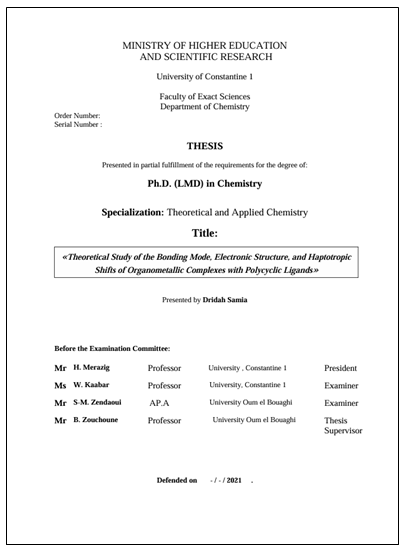
The cover page of a report holds significant importance, as it is the first visual element a reader encounters before delving into the document. Both its visual layout and written content must be carefully designed to create a strong first impression. The cover page should clearly and concisely include the title of the work, the author’s name, the supervisor and co-supervisor, the name of the academic institution, the submission date, and the members of the evaluation committee.
The title should convey the main idea of the work and highlight the key variables, if applicable. Abbreviations and overly general terms should be avoided. Ideally, the title should not exceed three lines, and if it does, the lines should be balanced for visual harmony.
Ø Dedication and Acknowledgements:
The dedication is a brief inscription made to honor or pay tribute to
someone. It is typically placed on a separate page that contains no other text.
The acknowledgements page is addressed to
individuals who, directly or indirectly, contributed to the completion of the
research work. It is customary to personally recognize the guidance and support
of the thesis supervisor, co-supervisor, internal advisor, and external
advisor, using terms that reflect the author’s own voice. Additionally, the
contributions of other individuals or institutions that played a significant
role may be acknowledged. The support of organizations that provided
scholarships, research funding, or grants can also be recognized.
5.2 Summary (Table of Contents):
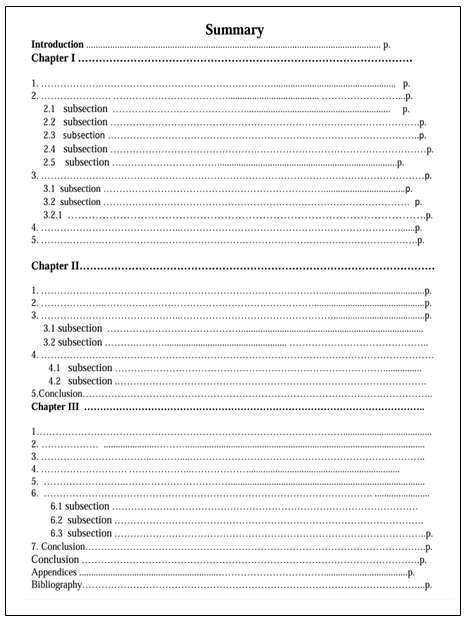
The table of contents immediately follows the title page and provides a detailed outline of the work. It includes:
- The title of each section of the work, including preliminary pages.
- The page numbers where the corresponding titles and subtitles appear.
Main section titles (e.g., Tables, Introduction, Development, Conclusion, Appendices, Bibliography) are written in uppercase letters, while subsections are written in lowercase letters.
The table of contents presents all sections and subsections of the work, along with references to their corresponding pages in the text. This allows the reader to quickly get an overview of the content and navigate directly to any section. Most word processing software can automatically generate a table of contents; refer to the software’s help menu for instructions.
5.3 Introduction :
The introduction sets the context of the problem, presents it clearly, emphasizes its significance, and outlines the approach used to address it. It typically includes a preliminary explanation of the methodology. The introduction should raise questions or highlight a paradox that justifies the continuation of the work.
It is written in the present tense, as it refers to the current state of knowledge and the problem at the start of the study. Under no circumstances should the introduction summarize the main body of the work or reveal the conclusions. The focus should remain on the essentials, skillfully presenting the main structure and organization of the text.
The introduction should engage the reader by capturing their attention and sparking interest in the topic. It provides necessary background information to place the hypothesis in a broader context and clearly states the central idea or guiding principle of the work. Additionally, it outlines the main ideas and structure of the study, indicating the major sections that will support the hypothesis.
5.4 Materials and Methods:
This section must provide all essential details that enabled the research, including the study site, studied species, and experimental setups or treatments. The information should be complete enough for any competent researcher to replicate the procedure.
Methods
This part describes, in order, the steps carried out during the experiment. It
should clearly explain what was done and how, while avoiding unnecessary
details. The aim is to allow another researcher to reproduce the results and
apply the same method in a similar study.
The experimental protocol should specify:
- the conditions under which the research was conducted;
- the subjects or samples studied (population, sampling method);
- the organization of the experiment (duration, treatments, number of observations, samples, repetitions);
- the observations made, including dependent and independent variables, and data collection procedures;
- the tools used for data analysis, mainly statistical methods;
- the accuracy and uncertainty of the instruments employed.
Recommendations
The choice of methods (including statistical tools) or equipment must be
justified, especially when reasonable alternatives exist. Detailed descriptions
of protocols already well-established in the literature are unnecessary; a
brief explanation with a reference is sufficient.
For clarity, the chapter may be divided into subsections. Universally known methods do not require detailed descriptions—referencing a bibliographic source is often enough and helps reduce the length of the text.
5.5 The development:
The development section is generally the largest part of the report, as it presents the work carried out and the results obtained. It must be organized according to the main objective of the study. The progression between sections should be smooth, which can be supported by short summaries at the end of each part when necessary. Additional information may also be included outside the main text—such as footnotes, references, appendices, or a glossary—to enhance clarity and support the reader’s understanding.
5.5.1 Results:
The fundamental rule of any research is to present the results objectively, whether they support the initial hypothesis or contradict it. The collected data are usually displayed in tables or figures, accompanied by explanatory text that highlights key points.
These results must then be analyzed and interpreted.
Ø Analysis and Interpretation of Results
Analysis involves organizing the collected information and processing it so that it can provide clear answers to the research questions. Interpretation, on the other hand, consists of linking these analytical findings to the researcher’s theoretical knowledge and the context of the study, in order to give them broader meaning.
In other words, analysis focuses on structuring and presenting the data, while interpretation refers to understanding and explaining their significance. Both steps require intellectual rigor to ensure the reliability and validity of the results.
b. Interpretation of Quantitative Data :
Quantitative data can be examined using mathematical and statistical methods. However, the quality of interpretation also depends on the researcher’s experience and judgment.
b. Interpretation of Qualitative Data:
Interpreting qualitative data is more complex because it relies heavily on the researcher’s personal skills—such as intuition, experience, observation, and analytical ability—rather than purely technical tools. It involves identifying patterns or meanings based on reflections and subjective analysis.
This chapter is generally written in the past tense. The present tense may be used when directly describing a table or figure, while the past tense is preferred when referring to completed analyses.
5.5.2 Discussion:
Unlike the “Materials and Methods” and “Results” chapters, which objectively describe how the study was conducted and what was observed, the Discussion section allows the author to express their own interpretation of the findings. Its quality reflects the researcher’s scientific background, analytical skills, and critical thinking. There is no universal structure for a discussion, but several guidelines can help in writing it effectively.
The Discussion is the core of the manuscript and requires the greatest amount of time, analysis, and reflection before reaching the conclusion. The author must sort, interpret, and connect the results to highlight their significance. A clear outline is essential before writing; otherwise, the reader may struggle to follow the author’s reasoning.
This chapter may alternate between past tense—when referring to the researcher’s own findings—and present tense—when discussing established facts or published studies.
Ø Objectives of the Discussion
The Discussion typically addresses three main objectives:
- Assess whether the aim of the study has been
achieved
The author must evaluate whether the objectives stated in the introduction were met and summarize the key findings that directly answer the research question. - Evaluate the quality and validity of the results
This involves a critical review of each chapter, identifying possible sources of bias, assessing the adequacy of the sample size, evaluating the appropriateness of the methods used, and interpreting the results based on methodological constraints and the power of the statistical tests. - Compare the findings with previous studies
The author should relate their results to those of other researchers and highlight their own scientific contribution or originality in addressing the research problem.
At the end of the Discussion, the author may formulate hypotheses, recommendations, or suggestions. These must be clearly identified as such. The Discussion may also conclude by acknowledging uncertainties or proposing avenues for future research.
5.6 Conclusion:
The conclusion aims to summarize the main reasoning of the work by recalling the key ideas, the hypothesis, and the logical links connecting them. It offers an overall perspective on the arguments developed throughout the study, brings the discussion back to the introduction, and formally closes the work.
The conclusion is not a simple summary but a final statement. It briefly retraces the intellectual process, highlighting the intermediate conclusions presented in the development. It then outlines the final points derived from the analysis, completing the demonstration.
Elements of the Conclusion
- Transition: Establish a clear link between the development and the conclusion, moving from specific ideas to broader statements that finalize the study.
- Summary: Synthesize the main ideas and demonstrate the logical relationships between them.
- Restatement of the Hypothesis: Reformulate the hypothesis in light of the arguments presented and reaffirm your position based on the findings.
- Opening: End smoothly by leaving a strong final impression. Place the hypothesis within a broader context by highlighting its implications for the field, future research, or society.
5.7 Bibliography:
The bibliography brings together all the sources that were consulted during the
preparation of the report. It consists of the works that are relevant to the
topic and is placed at the end of the document. Every reference cited in the
text must be listed in this section.
This list follows several conventions:
· The bibliography appears on a separate page at the end of the report.
· References are arranged alphabetically by the author’s last name. When several works by the same author are included, they are organized in ascending order according to the year of publication.
· Entries are single-spaced, with one blank line separating each reference.
· For each entry, the second and any subsequent lines must begin with a hanging indent of 1.25 cm from the left margin.
5.8 Appendices:
The appendices are placed immediately
after the conclusion and just before the bibliography. They contain documents
that are too detailed or too lengthy to be included in the main body of the
report, yet remain important for readers who may need to consult them.
Appendices provide additional information that supports the text while keeping
the main content clear and uncluttered. These materials may include
supplementary documentation, statistical data, questionnaires, charts, and
other extended elements.
They are used to present long or technical materials—such as large tables, technical datasets, specific quotations, extended mathematical formulas or derivations, computer programs, series of maps, or survey results—that would disrupt the flow of the main text or are not directly essential to the report’s central objectives. Reading the appendices is not required for understanding the core content of the report.
Each appendix must be numbered and titled. Appendices are usually identified using Roman numerals (I, II, III) or capital letters (A, B, C) and are arranged in the order in which they are mentioned in the text.
5.9 Abstract & Keywords :
5.9.1 Abstract :
The abstract is a concise summary of the study, written at the end of the research but usually placed at the beginning of the document. It provides an overview of each section: introduction, materials and methods, results, discussion, and conclusion.
A well-written abstract allows readers to quickly grasp the main points and decide whether to read the full work. It defines the scope of the study, highlights the key findings, and summarizes the research in about 100–150 words (not exceeding 200 words).
The abstract should focus on the research question and essential results, avoiding unnecessary background details. All relevant names, places, dates, and key concepts should be included.
5.9.2 Keywords:
Keywords (or descriptors) translate concepts from natural language (e.g., words used in the abstract) into controlled vocabulary. They summarize and describe the content of the study.
Typically, 4–6 keywords are chosen to facilitate indexing and database searches. It is recommended to select keywords not already included in the title to improve search efficiency.